Briefly explained
In short, a series of brief descriptions of terms and abbreviations commonly used in the openBIM environment. The purpose of In short is to demystify the jargon and ensure that everyone has the same understanding of the terms/abbreviations.
Dynamic concept and abbreviation map
The connections are semantic, not technical. The concept is under development - we welcome feedback for improvements.
Overview
buildingSMART standards and services
NS-EN ISO 19650 terms
AIR
AIM
PIR
PIM
EIR
OIR
BEP
LOIN
CDE
Information-
container
Condition/
status code
Order
Supplier
Leading
Supplier
Project group
Supplier group
TIDP
MIDP
NS 8360 concepts
Process status code
Level of development (LOD)
Custom property sets
Properties for process information
Procured
(English: IsProcured)
Milestone
(Norwegian: Milepel)
Control Zone
(English: Control Volume)
Duplicate object
(English: DuplicateOwnedBy)
Supplement
buildingSMART International has developed a set of standards to maintain openBIM information flow throughout the value chain.
The development and management of buildingSMART standards is handled by the organization buildingSMART International in collaboration with others such as ISO, OGC, etc.
Below you can see the buildingSMART standards and services included in the openBIM workflow (openBIM Workflow). Each of these will be further explained in the subsequent Short explanation:
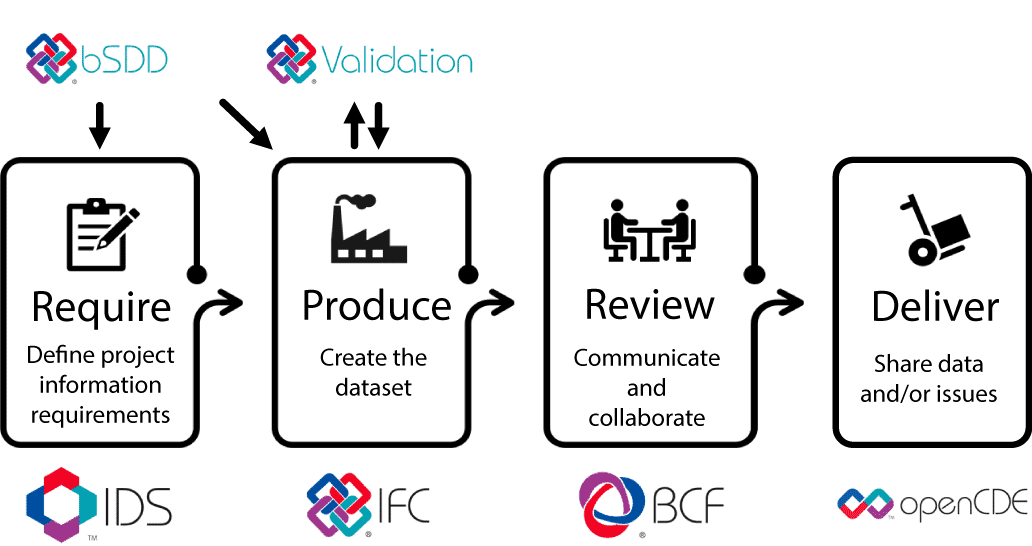
Information Delivery Specification (IDS) describes machine-readable requirements for information deliveries. It enables model checking in an automated manner.
Industry Foundation Classes (IFC) exchanges and stores model information. This is also an ISO standard NS-EN ISO 16739.
BIM Collaboration Format (BCF) communicates issues in model context.
BuildingSMART Data Dictionaries (bSDD) is a service that ensures information is described with common standardized definitions.
buildingSMART IFC Validation Service is a service that checks IFC files against the formal requirements of the standard and verifies whether the information follows the technical structure defined for a given IFC version.
openCDE describes a standardized set of interfaces (API) to facilitate the exchange and sharing of information between various Common Data Environments (CDE).
Abbreviated from Industry Foundation Classes. IFC is an ISO standard (NS-EN ISO 16739) which has been adopted in both European and Norwegian standardisation.
IFC is an international standard for building information. This makes it possible to exchange information about buildings so that the sender and receiver have the same understanding of what the object is, where the object is, what type it is, and its properties.
IFC can be exchanged in various formats. The format with the .ifc extension is the most widely used and is formally called STEP Physical Format (SPF or IFC-SPF). STEP files are in ASCII format (text format). It is also possible to exchange IFC model information using, among others, ifcXML.
Today, work is being done on various IFC versions. Some are working on IFC2x3, some on IFC4, and some are transitioning to IFC4.3, which is the latest version.
In addition to a data model for buildings, IFC4.3 includes bridges, roads, railways, waterways, and port facilities. IFC4.3 also contains the necessary information so that applications can transform between local coordinate systems and global map coordinate systems. Work is underway to develop IFC 4.4, which will include a data model for tunnels as well as some tidying up of the IFC standard
Additionally, work is being done on the next generation of the format, IFC5. This version will be based on modern data model architecture with ideas drawn from game development.
BCF
Abbreviated from BIM Collaboration Format. BCF is a process format that makes it possible to communicate issues in a model, showing the current location and connection to the relevant objects.
BCF makes it possible to report an issue and show other stakeholders the situation and which objects the issue relates to, as well as describing the issue using words and images, among other things.
Abbreviation of Information Delivery Specification. Is an open format for describing alphanumeric* requirements of the model. IDS can impose requirements on the information's structure, units, and values. It can be used, among other things, to automatically check the model's alphanumeric information against agreed requirements.
* Alphanumeric = information expressed with numbers or letters
buildingSMART Data Dictionaries
IFC Validation Service
A service that checks IFC files against the formal requirements of the standard and verifies whether the information follows the technical structure defined for a given IFC version. The validation service is particularly useful for newer versions of IFC, such as IFC4.3, where certification schemes are still under development or not fully established. A successful validation provides increased assurance that software produces technically correct IFC, even if it is not necessarily certified for the relevant version.
Validation does not replace certification or functional testing, but is an important supplement for assessing technical quality and compliance with standards.
openCDE
A standardized set of interfaces (API) to facilitate the exchange and sharing of information between various common data environments (CDE). These APIs ensure interoperability between different systems, thereby improving collaboration and efficiency in construction projects. They also contribute to easier integration of new tools and technologies, reducing the need for customized solutions and expensive software development. openCDE is developed by buildingSMART International. The OpenCDE API already includes the Foundation API, Documents API, BCF API, and bSDD API, with more on the way.
Foundation API: Basic services and conventions for all openCDE APIs
Documents API: The Documents API is designed to streamline the process of downloading and uploading files to a common data environment (CDE).
BCF API: The BCF API supports the exchange of BCF issues between software
bSDD API: The bSDD API offers methods for retrieving class and property information from many data dictionaries.
Project Information Model (PIM)
Project Information Model (PIM): A formal model used in the project phase to meet the client's requirements for information exchange (EIR) in accordance with the agreed BIM execution plan (BEP). PIM ensures that all project information is structured and up-to-date, which is essential for the coordination and execution of the construction project. All design disciplines with primary responsibility for building elements create their own discipline models. The discipline leader has formal responsibility for each discipline's PIM. This responsibility can be delegated to the person in charge of BIM planning in the project.
Information model for buildings (AIM, Asset Information Model)
A model used in the management phase to use and manage information about the building.
AIM is critical for the efficient operation and maintenance of the building. AIM increases awareness that it is not only the physical building that needs to be delivered. Information about buildings is at least as important. AIM helps ensure that the building is managed properly throughout its entire lifecycle.
The terms AIM and Digital Twin are often used interchangeably. According to the definition of Digital Twin from CEN, this requires real-time updates from the building. The Digital Twin is thus a more comprehensive integration of geometric models and other information.
AIM requires at a minimum an integration of geometric models in the FM system. Either in the form of integration of multiple solutions or the acquisition of a single integrated system.
The operations manager or administrator of the building is responsible for maintaining the information in AIM. Procedures must be established for how information is managed so that the information is up to date and there is control over what is master data and any copies of the information.
Information requirements and information models
Information models for both project (PIM) and management (AIM) are based on information deliveries according to requirements.
According to NS-EN ISO 19650-1, there are three sources for establishing requirements for information exchange (EIR). These safeguard the information needs of the client's line organization, the future manager of the building, and the project.
In addition to Requirements for Information Exchange (EIR), the Project Information Model is a result of the leading supplier's approach to how the requirements expressed in a BIM execution plan (BEP) should be delivered.
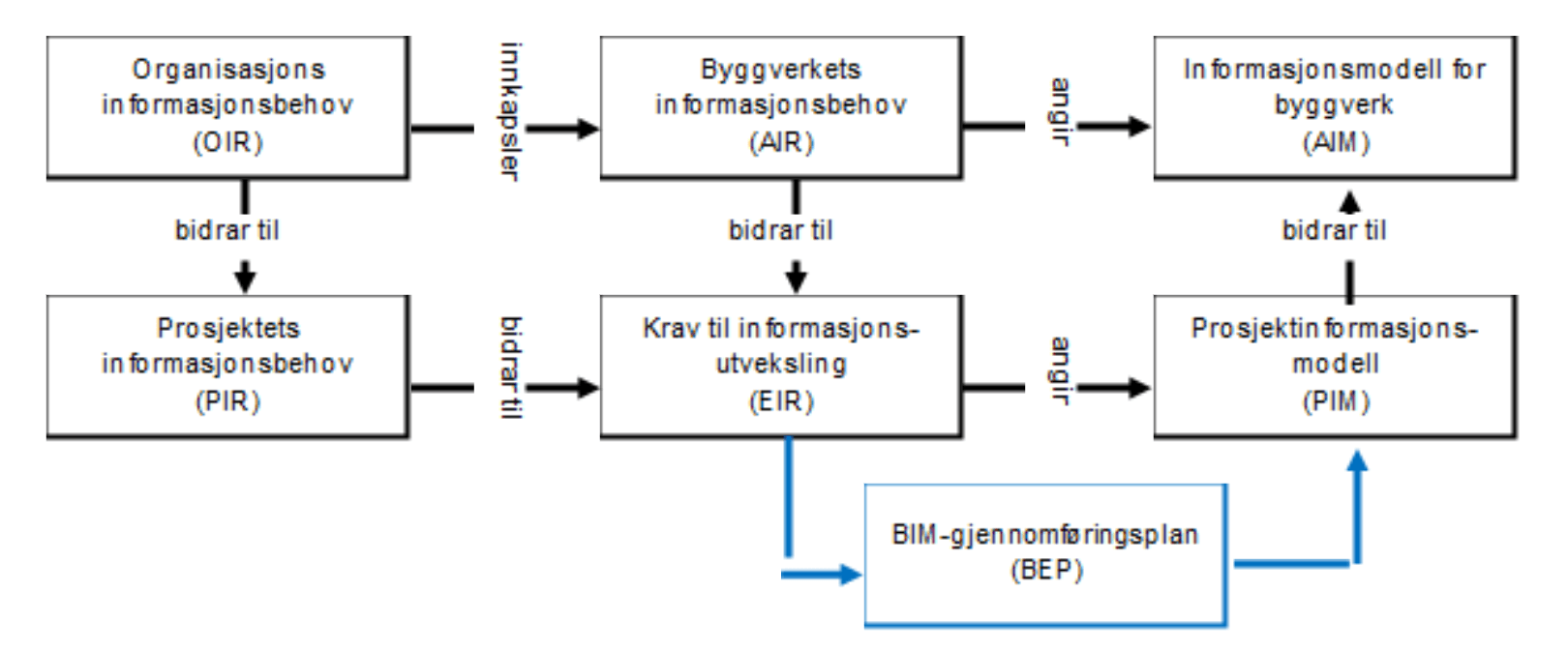
The organization's information requirements (OIR, Organization Information Requirements)
Information needs related to the ordering organisation's strategic high-level goals.
These requirements may arise from a range of circumstances, including strategic business operations, strategic management of buildings, portfolio planning, statutory obligations, or policy formulation. OIR ensures that the information collected and managed supports the organisation's overall goals and decision-making processes. Examples of specific requirements may include reporting to the line organisation on the project's status, an overview of the portfolio of buildings, environmental impact factors of the buildings, procurements, etc.
The line organisation's management or information officer is responsible for defining and maintaining the OIR. In the absence of clearly defined OIR from the line organisation, it will often be the project owner and/or project manager who will define these themselves.
The information requirements of the building (AIR, Asset Information Requirements)
Information needs for the management of the building. AIR is very important for ensuring effective management of the building.
Traditionally, there has been a strong focus on the delivery of the physical building and less on the delivery of information about the building. This must change if we are to succeed in more effective management and thus digital information management. Projects must prioritize delivering necessary information, including information models that represent what has actually been built and that support space management, system overviews, connections between geometry and documentation of systems and products.
The manager or operating responsible for the building is responsible for defining AIR as part of the information requirements for the project and ensuring that the deliveries are prioritized by the project management.
Project Information Requirements (PIR)
The PIR provides the information needed to respond to or provide information for high-level strategic goals for the client in relation to a specific construction project.
A set of information requirements should be developed for each of the client's main decision points throughout the project. When this is done, the client should consider the scope of the project, the intended purpose for which the client will use the information, the project's execution plan, the intended procurement method, the number of main decision points throughout the project, the decisions that the client needs to make at each main decision point, and the questions that the client needs answers to in order to make decisions based on the information.
Project management is responsible for defining and maintaining the PIR. Fixed clients can develop a general set of PIR that can be adapted, with or without changes, for all their projects.
Requirements for information exchange (EIR, Exchange Information Requirements)
Compilation of information requirements for a contract, including OIR, AIR, and PIR.
EIR defines in detail what information must be delivered and exchanged between actors. EIR includes a range of specifications such as the project's information standard, the project's methods and procedures for information production, the level of information need, information protocols, a list of shared resources, and a description of the Common Data Environment (CDE).
EIR ensures that the ordering and management organization receives the information they need. Information that suppliers require in addition to their own processes must be specified by the suppliers themselves, along with requirements for information exchange. The ordering party or project manager is responsible for preparing and maintaining the EIR.
BIM Execution Plan (BEP)
A plan that describes how information shall be managed and exchanged in the project according to the requirements expressed in the Requirements for Information Exchange (EIR).
The BEP ensures that all parties agree on how the supplier group shall deliver on the client's requirements for information exchange and how BIM processes shall be executed, promoting collaboration and efficiency. A BEP includes a number of specifications, including an approach to how the supplier group shall deliver on the requirements, suppliers' goals for information delivery, responsibility matrix, delivery schedules, competence and capacity for offered resources, common data environment (CDE).
The project manager of the leading supplier is responsible for the preparation of the BEP. The leading supplier's BIM manager is involved in the preparation and will often describe the technical aspects. It is important that the leading supplier and BIM manager agree on the approach and resource allocation.
Level of Information Need
The level of information describes the amount of information needed to meet specific needs in a project and ensures that all suppliers know exactly what information the client expects from them. The level of information defines all perspectives of specific information. The level of information should always describe a concrete purpose for the information, who is to deliver it, when it should be delivered, and how it should be delivered.
The level of information can describe requirements for geometric information that have multiple perspectives such as detail level; the level of information can describe requirements for alphanumeric information such as identification and properties, and the level of information can describe requirements for documentation.
The client's project manager is responsible for ensuring that the level of information is described. The responsible designer has the responsibility that the discipline delivers discipline models according to the described level of information.
Common Data Environment (CDE)
A shared digital platform for storing and exchanging project information. A CDE ensures that all project participants have access to the same information, which improves collaboration and reduces the risk of errors. The client's IT manager or CDE manager is responsible for managing and maintaining the CDE.
Information container
A package of information that may contain files, models, or documents. This ensures that the information is organized in a way that makes it easily accessible and manageable. Suppliers are responsible for creating and maintaining information containers.
Condition/status code
Metadata that describes the status of information containers showing the current status of information, whether it is in progress, shared, published (completed), or archived. Published indicates that the information has been made available for a specific purpose. This ensures that everyone knows who has access to the information containers and what they can be used for. This provides an overview of where the information is in the process, assisting in managing the flow of information. Project-related professionals are responsible for delivering and ensuring the quality that the information meets the requirements. The document responsible for the client indicates the status of information containers in the CDE.
Order
The one who orders information about the construction, for example, the client or contractor. The buyer sets requirements for what information is necessary and ensures that the project receives the necessary data. The client, general contractor, or main contractor can act in the role of the buyer.
Supplier
The one who provides information about the building. The supplier ensures that the correct information is delivered to the project at the right time. Architects, engineers, consultants, and contractors are responsible for the delivery.
Leading supplier
The one responsible for the contract with the supplier or supplier group. The lead supplier coordinates and ensures that all suppliers meet their information obligations. The main contractor or general contractor is responsible for the management.
Project group
The client and all supplier groups involved in the project. The project group ensures collaboration and coordination between all parties to ensure that project goals are met. All parties in the project, including the client and suppliers, make up the project group.
Supplier group
A group of suppliers who provide information about the building project. The responsibilities and tasks of the supplier group are described but are not defined in NS-EN ISO 19650. A supplier group ensures coordinated delivery of information and services to the project. The responsible party for organizing and leading the supplier group is often the main contractor or project manager.
Delivery plans for providing information (English: Task Information Delivery Plans, TIDP)
Delivery plan(s) for information (TIDP): A detailed plan that describes what type of information is to be delivered, by whom, and when in the project. The TIDP is important to ensure that all necessary information is delivered on time and in the right manner. Each individual supplier is responsible for developing and maintaining their TIDP.
Master Information Delivery Plan (English: Master Information Delivery Plan, MIDP)
Master Plan for Information Delivery (MIDP): A comprehensive plan that consolidates all subordinate plans (TIDP) for information delivery in the project. The MIDP provides an overall overview of information deliveries, which is essential for the project's progress and coordination. The project manager or BIM manager is responsible for developing and maintaining the MIDP.
Process status code
A code used to indicate the status of a process or activity, for example, whether it is in progress, completed, or approved. Process status codes are important for monitoring and managing the progress of the project. Document controllers or project managers are responsible for updating and maintaining process status codes.
Level of development (LOD)
Describes the requirements for the stepwise enrichment and maturity of the model with information. LOD ensures that information in the model is developed in an agreed manner and that it is sufficiently detailed for various project phases. LOD is described by the level of information (LOIN) and the main information delivery plan (MIDP). The project manager or BIM manager is responsible for defining and maintaining the LOD.
Custom property sets
Specific sets of properties that are defined to meet specific needs in the project. Custom property sets are essential to ensure that all necessary information is included in the model. The BIM manager or project leader is responsible for defining and maintaining these property sets.
Properties for process information
Specific characteristics that describe information related to various processes in the project. These characteristics are important to ensure that the processes are well-documented and can be followed up. The project manager or document controller is responsible for defining and maintaining the characteristics for process information.
Procured (English: IsProcured)
A property that indicates whether a specific component, service, or resource has been procured. This is a binary property that typically has the values "Yes" or "No". Knowing whether something is procured is important for tracking purchases and ensuring that necessary resources are available when needed.
PropertySet.Property: NONS_Process.IsProcured
Milestone (English: Milestone)
A feature that represents important events or milestones in the project. This can include the completion of specific phases, approvals, or other critical points in the project's timeline. Milestones help to monitor the project's progress and ensure that it stays on track.
PropertySet.property: NONS_Process.Milestone
ControlZone (English: ControlVolume)
A property that defines a specific area or volume within the project that is subject to control or specific restrictions. This can be areas where there are special security requirements, quality controls, or other conditions that must be met. Control zones are important to ensure that specific requirements are fulfilled within defined areas of the project.
Property set.property: NONS_Process.ControlVolume
Duplicate object (English: DuplicateOwnedBy)
The property indicates that the object is a copy, typically in the architectural discipline's model, and that there is another discipline responsible for designing and documenting the object. Copies are used, among other things, to ensure placement with the architectural design or to easily include the object in drawings or other extractions from the discipline model. The value for the property is the discipline responsible for the object, indicated by the abbreviation ARK, LARK, IARK, RIB, RIBr, RIV, RIVA, RIE, etc.
PropertySet.property: NONS_Process. DuplicateOwnedBy
Structured and unstructured information
Structured information refers to data that is organized and formatted in such a way that it can easily be stored, searched, filtered, and analyzed by computers. This type of information follows a set structure, such as tables or datasets with predefined fields.
Examples:
IFC files (Industry Foundation Classes): These are structured in a way that allows for standardization and sharing of data between different BIM software. Each component in an IFC file (such as a wall, door, or window) contains predefined properties, such as dimensions, materials, and location, in a structured format.
Datasets from databases: Information such as material lists, cost estimates, or schedules that are organized in table form with rows and columns that can be analyzed or linked to specific BIM objects.
Information whose meaning is explicitly defined in a data dictionary.
Unstructured information is data that is not organized in a fixed manner and often does not fit into a predefined structure such as a table or database. This type of information can be more difficult to process and analyze using traditional data processing methods.
Examples:
PDF documents: These may contain building plans, specifications, or contracts that are not easily searchable or structured for automatic data extraction.
Email communication: Correspondence between project members that may contain important information but is not systematically organized.
Images and sketches: Image files or hand-drawn sketches related to the project that are not structured in a way that makes them readily accessible for data processing.
When we want to digitize in order to automate, we desire as much machine-readable information as possible, thus ensuring that as much information as possible is structured.
Artificial intelligence can to some extent derive structured information from unstructured information, so the difference between the purposes for which these two types of information can be used varies.