
Publications and guidelines

Here you will find buildingSMART Norway's publications and guidelines. The material is developed to support the industry in the practical use of openBIM, open standards, and good digital information flow – from planning and design to operations and management.

POFIN 1.0

POFIN is a national framework for BIM developed and managed by buildingSMART Norway.

The framework includes guidelines, pre-defined requirements for information deliveries for buildings, and templates.

POFIN supports:

Establishing requirements
The agreement process between the client and supplier
Establishing a common data environment
Project follow-up
Digitalisation of existing buildings
Use of BIM models as part of the facility management documentation.

POFIN includes 14 text documents and two spreadsheets. The framework is modular, so you only need to use the parts that support the tasks you are facing. For more information on this, download the Zip file with the entire documentation and read part 1 which explains how POFIN should be used.
POFIN 1.0

MMI-veilederen 2.0

MMI, or Model Maturity Index (Norwegian: Modell Modenhets Indeks), describes the maturity of the objects in building models using agreed numerical codes. MMI is primarily a methodology for communication and management processes in the project phase and operational phase of a building.

MMI-veilederen 2.0

IFC for beginners - and beyond

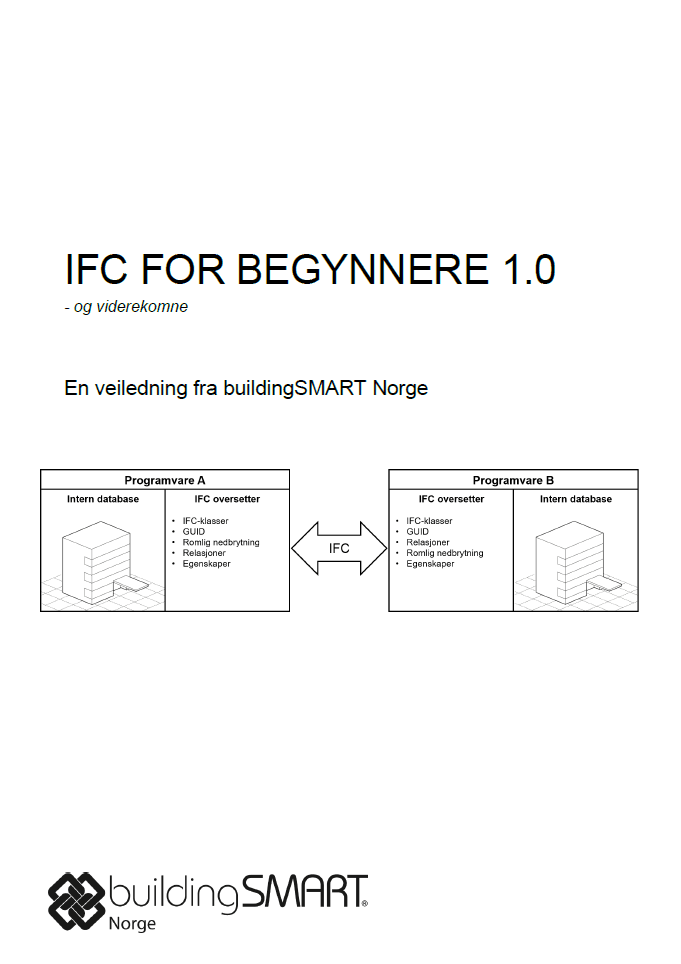
The guide provides a practical and educational introduction to IFC for anyone who encounters IFC in projects and asset management.
It explains what IFC is, how the standard is structured, and how IFC is used to structure and exchange information about buildings and infrastructure. The guide also describes common issues and practical trade-offs when using IFC.
The goal is to provide the reader with a basic understanding to be able to set precise requirements, verify deliveries, and use IFC models in a conscious manner. The guide is a common Norwegian reference for how IFC should be used.

IFC for beginners - and beyond

The business value of openBIM

The Business Value of IFC
What is the business value of adopting open data formats in the building, construction, and property industry? This report shows how IFC can contribute to better collaboration, fewer errors, more efficient project delivery, and a stronger foundation for operations, sustainability, and digital development. The report is aimed at clients, consultants, contractors, product manufacturers, and public actors, and highlights how open standards can create measurable value across the entire value chain.

The business value of openBIM

Guidelines for VA detail models 1.0

Guidelines for VA detail models 1.0 are an industry standard from buildingSMART Norway, developed in collaboration with the Water and Wastewater Department in Oslo. The document provides common guidelines, minimum requirements, and recommended practices for modeling detailed VA objects, with a primary focus on manholes, pipes, and pipe equipment for outdoor VA facilities.

The guidelines are based on open BIM standards and are derived from IFC 4.3, which has been developed for infrastructure. The purpose is to ensure that digital information is developed in a consistent and structured manner, allowing it to be used effectively throughout the entire lifecycle of a VA facility, from planning and design to construction, handover, and operation.

The document describes model structure, information requirements, and geometric requirements at a detailed level, as well as defining key use cases such as interdisciplinary coordination, information control, cost estimation, construction phase, and operation and maintenance. The guidelines aim to contribute to better collaboration, higher data quality, and increased reuse of information across stakeholders, tools, and projects in the VA industry.

Guidelines for VA detail models 1.0

Rebar Guide 2.0

The document has been prepared by buildingSMART Norway's working group for rebar, hereafter referred to as the rebar group. buildingSMART Norway's Rebar group works to facilitate digital ordering and construction of rebar in projects in Norway.

The guide maps the current situation and describes future ambitions. The members of the group are specialists in digital rebar and engage in the network with the aim of creating a smoother flow of agreed data in the process of producing rebar based on information from models on open standards. The rebar group is led by Marcus Rodriguez from BuildingPoint/EDR Medeso.

Rebar Guide 2.0

openBIM Harmony

openBIM Harmony is a framework of guidelines, templates, and predefined information requirements designed to help specify and manage information delivery in BIM projects. It is based on the EN ISO 19650 series and CEN/TR 17654, and is adaptable to national needs. POFIN is based on openBIM Harmony. The framework is freely available and can be downloaded here from the website.

Download openBIM Harmony here

Questions? Contact steen@buildingsmart.no

_______

openBIM Harmony is a framework of guidelines, templates, and predefined information requirements designed to help specify and manage information delivery in BIM projects. It is based on the EN ISO 19650 series and CEN/TR 17654, and is adaptable to national needs. The Framework is meant to be adapted by Chapters in National implementations. The framework is freely available and can be downloaded here from the website.

Download openBIM Harmony here

Questions? Contact steen@buildingsmart.no

openBIM Harmony